Showing posts with label fatigues. Show all posts
Showing posts with label fatigues. Show all posts
Tuesday, August 27, 2019
Handbook Updates
I've made several edits and additions to the CCC Uniforms Handbook recently. Highlights include a new section on civilian denim chore coats in workwear, a revised discussion of procurement of civilian service-style shirts during the mobilization years in early dress uniforms, and a new entry for the late spruce-green dress Mackinaw coat (companion garment to the spruce green tunic) in Outerwear.

Tuesday, August 20, 2019
Personalized CCC Wear #1: Coopers Rock State Park Company 3527 Cossack Jacket
Personal alteration or decoration of CCC-issued clothing was prohibited by regulation. Uniform clothing was "GFE"-- Government Furnished Equipment. As a 1940 Enrollee Handbook sternly admonished,
"All clothing is purchased and issued by the Army. The company commander is responsible for enrollee's clothing, as he is for all government property. The enrollee's uniform is issued for wear during his stay in the CCC... . During his stay in camp he is required to use and protect his uniform as he is other government property... . Enrollees are required to take the utmost care of all clothing issued them. While replacements will be made for articles worn out in regular use, the cost of clothing lost or destroyed is charged against the enrollee's pay."
It followed that defacing uniform parts with personal markings was strictly forbidden. The existence of the famous bell-bottom pants modification to the wool dress trousers suggests that many camp commandants took a relaxed attitude toward the letter of this rule when it came to alterations. However, vintage photographs otherwise confirm the message of the handbook: enrollees were not to embroider, deface, or otherwise personalize their issued clothing.
That said, I have so far encountered two examples of very personalized CCC-related clothing. Each is almost certainly a private-purchase garment, to which the ban on altering government property did not apply.
First up is this fascinating whipcord cossack jacket. An enrollee named George Morgan evidently served with Company 3527, building the beloved Cooper's Rock State Park on the Cheat River Canyon 12 miles east of Morgantown, West Virginia. He was apparently so proud of his association with the CCC and this project that he had his private work jacket customized as a memento.
Morgan's jacket is itself quite interesting. In the 1930s, "cossack jacket" was the generic term for a trim waist-length jacket. The earliest such jackets were made of leather and were close cousins or derivatives of the military A1 flight jacket. As the style spread, other variations were made in every conceivable fabric, including wool and cotton. Morgan's jacket seems to push the cossack style towards a fusion with the civilian chore coat. It retains the trim cossack cut, but employs a heavy blue corded fabric more like what would usually have been used in a loose-cut overall or work coat. It includes a falling collar, two slash hand warmer pockets, a single zipper-closed utility pocket with an ornamental pull chain on the left breast, and fabric straps with buckles to adjust the fit at the waist. Visually, it anticipates by a decade or more the combination of workaday fabric and a trim fit that would come together definitively in 1953 in the iconic Levi's 507 "Type 2" trucker jacket of Elvis Presley fame.
But what really fascinates is the stunning custom embroidery -- name stitched on breast, and on the back panel, park name, plains Indian-style chief's head, and Company number and town name. The overall effect is stunning -- artistically, this is a postwar motorcycle club jacket a full 10 to 15 years before such things came to be in wider American culture. So uncanny is the resemblance to an MC "cut" that it is tempting to think the jacket might have been embroidered in the late 1940s or 1950s as a retrospective memento. But it otherwise is clearly of true 1930s manufacture, and other than the uncanny pre-figuration of the MC style, there is no reason to believe the needle art is not prewar as well.
Whatever its probably never-to-be-known origin story, it is one of a kind -- perhaps one of the very earliest examples of a style of embroidery that would, in the hands of disaffected vets after World War II, become the iconic MC cut of Easy Rider and Sons of Anarchy notoriety.


Friday, May 17, 2019
Mobilization Expedient: Civilian "Levis 501-style" Denim Trousers
In an earlier post I highlighted a remarkable high-resolution photograph of the boys of Company 720, Baudette, Minnesota, 1933, collection of the Minnesota Historical Society. High resolution version available from MHS.
In that first post I singled out for attention the remarkable custom-printed CCC sweatshirt one boy is wearing. Taking a second look, I'm reminded that many boys in this image are also wearing civilian blue jean trousers, a notable deviation from standard CCC practice.
Below are screen captures of three boys from this group wearing jeans with arctuate hanging front pockets and reenforcing rivets in the general style defined by Levis 501s of the 1930s.


It seems likely that when this company was outfitted during the initial mobilization rush, the regional QMC depot had a shortage of Army denim fatigue coverall trousers and went into the market for a civilian substitute.
These jeans serve as a reminder that, when it comes to CCC-issue clothing, there is an exception to every rule. Issue of civilian-cut denim dungarees to a CCC company was clearly rare. Overwhelmingly, the denim work pants on CCC boys in vintage images are standard post-1919 US Army fatigue coveralls. However, in an organization as sprawling as the CCC, mobilized under such hasty conditions, expedients abounded. Sometime and somewhere, if it could happen, it probably did.
In any event, if you are a reenactor interested in creating a CCC impression, and want to wear your prized pair of full-cut, straight-leg 1933 selvage denim Levi's instead of boring M1937 fatigues, go for it. Now you have the image to make your case.
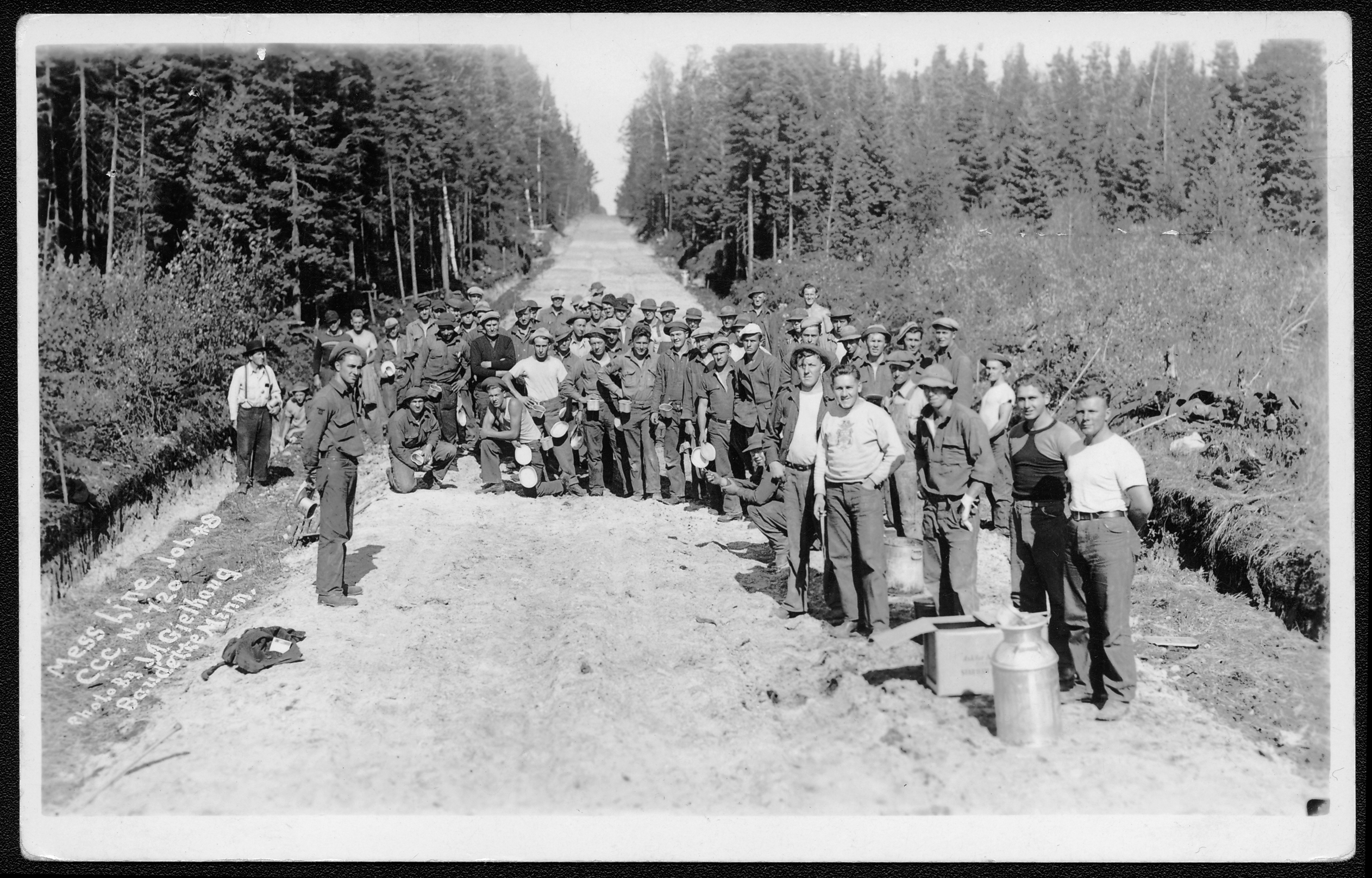
In that first post I singled out for attention the remarkable custom-printed CCC sweatshirt one boy is wearing. Taking a second look, I'm reminded that many boys in this image are also wearing civilian blue jean trousers, a notable deviation from standard CCC practice.
Below are screen captures of three boys from this group wearing jeans with arctuate hanging front pockets and reenforcing rivets in the general style defined by Levis 501s of the 1930s.


It seems likely that when this company was outfitted during the initial mobilization rush, the regional QMC depot had a shortage of Army denim fatigue coverall trousers and went into the market for a civilian substitute.
These jeans serve as a reminder that, when it comes to CCC-issue clothing, there is an exception to every rule. Issue of civilian-cut denim dungarees to a CCC company was clearly rare. Overwhelmingly, the denim work pants on CCC boys in vintage images are standard post-1919 US Army fatigue coveralls. However, in an organization as sprawling as the CCC, mobilized under such hasty conditions, expedients abounded. Sometime and somewhere, if it could happen, it probably did.
In any event, if you are a reenactor interested in creating a CCC impression, and want to wear your prized pair of full-cut, straight-leg 1933 selvage denim Levi's instead of boring M1937 fatigues, go for it. Now you have the image to make your case.
Sunday, May 12, 2019
Object(s) of the Day: Deadstock Denim Fatigue Uniform Assemblage
In researching the CCC Uniforms Handbook I came across a remarkable post from May 2015 in the "Denimbros" forum, in which forum member Charles DiSipio of Historic Preservation Associates, the US rep for Buzz Rickson, presents a complete denim work uniform in pristine, deadstock condition from his personal collection.
The assemblage includes the M1937 denim pullover and trousers, heavy leather gloves, underwear and socks, as well as a rare pair of russett leather garrison shoes--the lighter, lined variant of the Service Shoe issued prior to World War II. The individual items were made under a mixture of CCC and USA contracts. The assemblage was issued as a group to a US Army Air Force enlistee; however, it every item in it could have equally well been issued to a CCC enrollee.
This is as close as any of us will ever come to seeing complete, skin-out CCC work uniform in original, as-issued condition. Visit and enjoy the complete post and detailed photographs at:
https://www.denimbro.com/ccc-u-s-army-uniform-work_topic1679.html

The assemblage includes the M1937 denim pullover and trousers, heavy leather gloves, underwear and socks, as well as a rare pair of russett leather garrison shoes--the lighter, lined variant of the Service Shoe issued prior to World War II. The individual items were made under a mixture of CCC and USA contracts. The assemblage was issued as a group to a US Army Air Force enlistee; however, it every item in it could have equally well been issued to a CCC enrollee.
This is as close as any of us will ever come to seeing complete, skin-out CCC work uniform in original, as-issued condition. Visit and enjoy the complete post and detailed photographs at:
https://www.denimbro.com/ccc-u-s-army-uniform-work_topic1679.html

Subscribe to:
Posts (Atom)
-
 In an earlier post I highlighted a remarkable high-resolution photograph of the boys of Company 720, Baudette, Minnesota, 1933, collection ...
 -
I've made several edits and additions to the CCC Uniforms Handbook recently. Highlights include a new section on civilian denim chore c...
-
 Personal alteration or decoration of CCC-issued clothing was prohibited by regulation. Uniform clothing was "GFE"-- Government F...