Friday, February 14, 2020

New Source for Pattern 1918 Field Trousers

Reenactors rejoice! Jerry Lee of What Price Glory has just brought to market a new reproduction of the Pattern 1918 wool field trousers which where the universal dress pant of the CCC during the Mobiliation Era, 1933-1935. 

Until now, the only source for these trousers was a limited cache of deadstock reproduction trousers from Paul Schipper of the former Schipperfabrik concern, being marketed until exhausted by Man the Line.

Given that no reproduction of the CCC-specific OD33 shade 8-83 trousers of the 1935-39 era has ever been offered, these trousers are the single best option for an accurate impression of a CCC OD dress uniform.  Get them while you can.

Sunday, November 17, 2019

Clothing Table of Allowances, 1937 War Department Civilian Conservation Corps Regulations

Below is the table of allowances provided in the 1937 War Department Regulations for the Civilian Conservation Corps. Items of interest include the notation phasing out the altered WWI tunics, overcoats and jerkins, and the mobilization-era "windbreakers".


Director Fechner Comments on Clothing, FY 1938 Annual Report


In the Annual Report of the Director of the Civilian Conservation Corps for the Fiscal Year Ending June 30 1938, Director Robert Fechner had the following remarks to make about clothing:

Clothing Varied when Necessary

The quality of and the workmanship on the various garments purchased and issued is good because long experience has demonstrated that lowest net costs are produced through the purchase of materials of very good quality finished with excellent workmanship. As with the food purchased the clothing is all bought to exacting specifications. Buying is done by the Quartermaster Corps United States Army which maintains very rigid inspection to see that goods purchased comply with specifications.

While most of the items which make up the clothing outfits of the enrollees are standard all over the country a number of items are not This is accounted for by the great climatic differences encountered in a country as large as the United States. Special wool and fur garments are issued to enrollees in places where extreme cold is encountered. The issue of similar garments to enrollees in hot desert locations would of course be ridiculous. Special tropical clothing items are issued tomen in very warm locations. Often due to unusual geographical or work conditions other special items of clothing are issued. Men who work along a cliffside are often issued hard high crowned crash-helmets to protect them against being injured by falling pebbles or slivers of rock. Thus, clothing is standardized wherever possible but when special needs arise special clothing items are furnished to meet the needs.

Increasing emphasis has been placed on obtaining and issuing clothing which fits well and looks well in addition to wearing well. This is done to build up the individual's pride and interest in his appearance because personal appearance is often so vital a factor in obtaining and holding a job. When an enrollee leaves the Corps at the end of his term of enrollment he is given adequate clothing to insure a comfortable trip home. While he is at the camp the enrollee is free to wear his own clothing within very broad limits if he wishes to do so in preference to that which is issued. The enrollee who goes to town for the evening or who is given a week end leave or other leave is not required to wear the clothing issued to him but may do so if he wishes.

Tuesday, August 27, 2019

Handbook Updates

I've made several edits and additions to the CCC Uniforms Handbook recently.  Highlights include a new section on civilian denim chore coats in workwear, a revised discussion of procurement of civilian service-style shirts during the mobilization years in early dress uniforms, and a new entry for the late spruce-green dress Mackinaw coat (companion garment to the spruce green tunic) in Outerwear.

Friday, August 23, 2019

Personalized CCC Wear #2: Betty Boop and Popeye Moleskin Vest

Along with the Cooper's Rock MC-style cossack jacket, I have tripped across one other example of a truly personalized garment associated with the CCC -- a work or hunting vest hand-decorated with pen-and-ink cartoon sketches and a freehand CCC logo.

I found images of this garment in a blog post with no further information provided.

This jerkin appears to be made of moleskin, a heavy cotton fabric woven and then sheared to create a short, soft pile on one side. Moleskin was a common choice for durable workwear in midcentury, often used as an alternative to whipcord or canvas duck.  

The collar includes a tag identifying the manufacturer as Buck Szein or Buck Stein, with a buck image. The buck iconography is surely a play on the manufacturer's brand name, but may also suggest the core market might have been hunters and outdoorsmen. The vest includes two patch front pockets with slightly angled top entry and is closed with a Talon zipper. The waist includes fabric tabs and buckles on each side for adjusting the fit.

The vest is ornamented on both sides with a variety of quite well executed hand-drawn pen and ink markings. On the right front breast is a cartoon of Betty Boop, the animated cartoon character created by Max Fleischer. A caricature of a Jazz Age flapper, Betty made her film debut in August 1930. On the right front pocket is a set of monogram initials in a circle -- they seem to be S and B flanking a center C.

On the back center of the vest is a hand-drawn shield with the letters CCC and the legend Civilian Conservation Corps.  Below it is another fine cartoon featuring Betty with Popeye the Sailor. Popeye was another Fleischer creation; he debuted side by side with Betty in 1933's "Popeye the Sailor with Betty Boop," which combined Popeye's origin story with an animated short featuring the established and very popular Betty.

This was surely a private purchase item decorated by its owner, a CCC enrollee.  

The anonymous owner seems to have identified with Popeye, the tough guy with a heart of gold. In the famous theme song, written by Sammy Learner, Popeye proclaims that


I'm Popeye the Sailor Man. I'm Popeye the Sailor Man.
I'm strong to the finich, cause I eats me spinach.
I'm Popeye the Sailor Man.
I'm one tough Gazookus, which hates all Palookas.
Wot ain't on the up and square.
I biffs 'em and buffs 'em and always out roughs 'em
and none of 'em gets nowhere.
If anyone dares to risk my "Fisk", It's "Boff" an' it's "Wham" un'erstan'?
So keep "Good Be-hav-or", That's your one life saver
With Popeye the Sailor Man.
He's Popeye the Sailor Man, He's Popeye the Sailor Man.
He's strong to the finich, cause he eats his spinach.
He's Popeye the Sailor Man.


Popeye's combination of toughness and chivalry would have been a remarkably good match for the values promoted among enrollees by the 3C's, with its "We can take it!" motto and ethos.


Tuesday, August 20, 2019

Personalized CCC Wear #1: Coopers Rock State Park Company 3527 Cossack Jacket


Personal alteration or decoration of CCC-issued clothing was prohibited by regulation. Uniform clothing was "GFE"-- Government Furnished Equipment.  As a 1940 Enrollee Handbook sternly admonished,

"All clothing is purchased and issued by the Army. The company commander is responsible for enrollee's clothing, as he is for all government property. The enrollee's uniform is issued for wear during his stay in the CCC... . During his stay in camp he is required to use and protect his uniform as he is other government property... . Enrollees are required to take the utmost care of all clothing issued them. While replacements will be made for articles worn out in regular use, the cost of clothing lost or destroyed is charged against the enrollee's pay."

It followed that defacing uniform parts with personal markings was strictly forbidden. The existence of the famous bell-bottom pants modification to the wool dress trousers suggests that many camp commandants took a relaxed attitude toward the letter of this rule when it came to alterations. However, vintage photographs otherwise confirm the message of the handbook: enrollees were not to embroider, deface, or otherwise personalize their issued clothing.

That said, I have so far encountered two examples of very personalized CCC-related clothing. Each is almost certainly a private-purchase garment, to which the ban on altering government property did not apply.

First up is this fascinating whipcord cossack jacket. An enrollee named George Morgan evidently served with Company 3527, building the beloved Cooper's Rock State Park on the Cheat River Canyon 12 miles east of Morgantown, West Virginia. He was apparently so proud of his association with the CCC and this project that he had his private work jacket customized as a memento.

Morgan's jacket is itself quite interesting. In the 1930s, "cossack jacket" was the generic term for a trim waist-length jacket. The earliest such jackets were made of leather and were close cousins or derivatives of the military A1 flight jacket.  As the style spread, other variations were made in every conceivable fabric, including wool and cotton. Morgan's jacket seems to push the cossack style towards a fusion with the civilian chore coat. It retains the trim cossack cut, but employs a heavy blue corded fabric more like what would usually have been used in a loose-cut overall or work coat. It includes a falling collar, two slash hand warmer pockets, a single zipper-closed utility pocket with an ornamental pull chain on the left breast, and fabric straps with buckles to adjust the fit at the waist. Visually, it anticipates by a decade or more the combination of workaday fabric and a trim fit that would come together definitively in 1953 in the iconic Levi's 507 "Type 2" trucker jacket of Elvis Presley fame.

But what really fascinates is the stunning custom embroidery -- name stitched on breast, and on the back panel, park name, plains Indian-style chief's head, and Company number and town name. The overall effect is stunning -- artistically, this is a postwar motorcycle club jacket a full 10 to 15 years before such things came to be in wider American culture. So uncanny is the resemblance to an MC "cut" that it is tempting to think the jacket might have been embroidered in the late 1940s or 1950s as a retrospective memento.  But it otherwise is clearly of true 1930s manufacture, and other than the uncanny pre-figuration of the MC style, there is no reason to believe the needle art is not prewar as well.

Whatever its probably never-to-be-known origin story, it is one of a kind -- perhaps one of the very earliest examples of a style of embroidery that would, in the hands of disaffected vets after World War II, become the iconic MC cut of Easy Rider and Sons of Anarchy notoriety.


Tuesday, May 21, 2019

New Reproduction Service Shoes - Type I Pattern with All-Leather Sole

For the first time, a replica of the Army Service Shoe with a leather rather than composition sole is now available. The new shoe has been brought to market by SM Wholesale, a noted vendor of replica uniforms for film and TV productions.

Up to now, no one has made an "off the rack" Type I Service Shoe--all prior replicas match the US Army Type II pattern with rubber heels and taps.

As the Handbook discusses, there is ample evidence to justify wearing service shoes with composition soles for CCC impressions. That said, a purist CCC living historian might prefer SM Wholesale's new leather sole service shoe as a still-closer approximation to the true early 1930s shoe which would have had both a leather sole and a stacked leather heel.  

In making a choice, quality may enter into the calculation. Among WWII reenactors SM Wholesale has a reputation for goods which are affordable, but more "prop grade" that "heritage grade" in materials and workmanship. I cannot speak to the quality of these new 1930s service shoes, but I do have a pair of SM's black US Navy oxfords as a stand-in for the CCC low-quarter "sturdy black shoes," and the workmanship and materials of my SM oxfords are indeed a cut below heritage grade, though not out of line with the price point.

I would be eager to hear from anyone who gives these new SM Wholesale Type 1 service shoes a try.


Friday, May 17, 2019

Mobilization Expedient: Civilian "Levis 501-style" Denim Trousers

In an earlier post I highlighted a remarkable high-resolution photograph of the boys of Company 720, Baudette, Minnesota, 1933, collection of the Minnesota Historical Society. High resolution version available from MHS.

In that first post I singled out for attention the remarkable custom-printed CCC sweatshirt one boy is wearing. Taking a second look, I'm reminded that many boys in this image are also wearing civilian blue jean trousers, a notable deviation from standard CCC practice.

Below are screen captures of three boys from this group wearing jeans with arctuate hanging front pockets and reenforcing rivets in the general style defined by Levis 501s of the 1930s.


It seems likely that when this company was outfitted during the initial mobilization rush, the regional QMC depot had a shortage of Army denim fatigue coverall trousers and went into the market for a civilian substitute.

These jeans serve as a reminder that, when it comes to CCC-issue clothing, there is an exception to every rule. Issue of civilian-cut denim dungarees to a CCC company was clearly rare. Overwhelmingly, the denim work pants on CCC boys in vintage images are standard post-1919 US Army fatigue coveralls. However, in an organization as sprawling as the CCC, mobilized under such hasty conditions, expedients abounded. Sometime and somewhere, if it could happen, it probably did.

In any event, if you are a reenactor interested in creating a CCC impression, and want to wear your prized pair of full-cut, straight-leg 1933 selvage denim Levi's instead of boring M1937 fatigues, go for it. Now you have the image to make your case.


Sunday, May 12, 2019

Object(s) of the Day: Deadstock Denim Fatigue Uniform Assemblage

In researching the CCC Uniforms Handbook I came across a remarkable post from May 2015 in the "Denimbros" forum, in which forum member Charles DiSipio of Historic Preservation Associates, the US rep for Buzz Rickson, presents a complete denim work uniform in pristine, deadstock condition from his personal collection.

The assemblage includes the M1937 denim pullover and trousers, heavy leather gloves, underwear and socks, as well as a rare pair of russett leather garrison shoes--the lighter, lined variant of the Service Shoe issued prior to World War II. The individual items were made under a mixture of CCC and USA contracts. The assemblage was issued as a group to a US Army Air Force enlistee; however, it every item in it could have equally well been issued to a CCC enrollee.

This is as close as any of us will ever come to seeing complete, skin-out CCC work uniform in original, as-issued condition.  Visit and enjoy the complete post and detailed photographs at:

https://www.denimbro.com/ccc-u-s-army-uniform-work_topic1679.html


Featured Reenactor: CCC Living History at Maryland State Parks' Senior Rangers

Senior Rangers is a new program developed by Maryland Park Service Ranger Jamie Petrucci of Patapsco Valley State Park, now also extended to Seneca Creek State Park under the direction of Ranger Shelby Smith. It offers active adults 55 and over an opportunity to explore the natural, cultural, historical and recreational opportunities of Maryland's parks through weekly explorations guided by Maryland Rangers and other DNR staff.

This spring I was honored to bring my character, "George Richter Jr." of Company 326, Camp S52, New Germany Recreation Area, to both Senior Ranger Programs.  Below are images of "George" interacting with the Senior Rangers.


Featured Reenactor: Civilian Conservation Corps Company 1860 (Veterans)/Camp SP-13 Red Rocks -- August 2019

Plans are in the works for a very exciting living history presentation later this year at one of the most iconic CCC sites: the world-famous Red Rocks Amphitheater in Morrison, CO near Denver.

Though the music venue itself is known nationally and internationally, few are aware that the CCC camp which housed Company 1860, the builders of the venue, also survives in remarkably intact condition.  Denver Parks has begun a program to rehabilitate the camp structures and open some of them to the public: https://denverite.com/2018/04/30/red-rocks-camp-rebuild/.

Denver Parks rangers are working with Mr. Mark Headlee to plan a reenactment of life in Veteran's Company 1860 at Red Rocks, with a tentative date in August 2019.  This promises to be one of the  most exciting CCC living history events of the year.

Details will be provided here as plans mature.

Saturday, May 11, 2019

Object of the Day: M1910 canteen from SCS5, Camp Chester, CA

M1910 canteen, Aluminum Goods Manufacturing Co. (AGM Co) 1918 manufacture date, issued to a CCC boy in California. He scratched it with his camp name, Camp Chester, and a list of work sites: Vacaville, Winters, Dixon, Sacramento and Oroville. On the other side is what seems to be either a camp code or his initials (too faint to read), plus SCS, USF, CCC, and ECW. Vertically on one side is U.S. CCC.  The owner was most likely in Camp SCS5, Company 4233 or 2933, working mostly on soil projects in the Central Valley. Canteen now in collection of the author.


New Jacket Added to Outerwear

Thanks to the distinguished militaria collector Mr. Kenneth Lewis, author of Doughboy to GI: US Army Clothing and Equipment 1900-1945, I have received photographs of an original CCC shawl-collared work jacket in plaid Mackinaw cloth from his collection.

In earlier versions of the Handbook, I expressed strong skepticism that this garment actually existed, as I had seen no original examples, nor can I locate an example in period photographs.  I am delighted to say I was wrong; Mr. Lewis's plaid work coat has now been added to the Handbook in the outerwear section.

I also owe an apology to Buzz Rickson for casting doubt on the authenticity of their 2017 plaid CCC work jacket replica. As it turns out, Buzz's plaid CCC jacket is identical to Mr. Lewis' original, right down to the spec date and contract date on the replica tag.  All honor to Buzz for crafting a superlative replica.

The Real McCoy also currently offers a replica plaid CCC work jacket. While not doubt of the same fine quality as all McCoy garments, it does not match the original example in Mr. Lewis' collection as closely as does the Rickson garment, having a bolder plaid pattern and simpler lines to the pockets and flaps. The differences could be artistic license, or, they could reflect McCoy working from a different and so-far unknown alternate original example. As always with CCC wear, much remains to be discovered.

Wednesday, April 24, 2019

Photo of the Day: Company 720, Baudette, Minnesota, 1933

Mess Line of the boys of Company 720, Baudette, Minnesota, 1933, collection of the Minnesota Historical Society. High resolution version available from MHS. By all means click through to the full version and feast your eyes on the civilian belts, undershirts, and hats and the mobilization-era uniform parts. Don't miss the fascinating CCC sweatshirt on the boy center-right foreground--likely a camp-specific custom design silkscreened onto a stock oatmeal-colored Champion or similar sweatshirt by a local sports team outfitter.
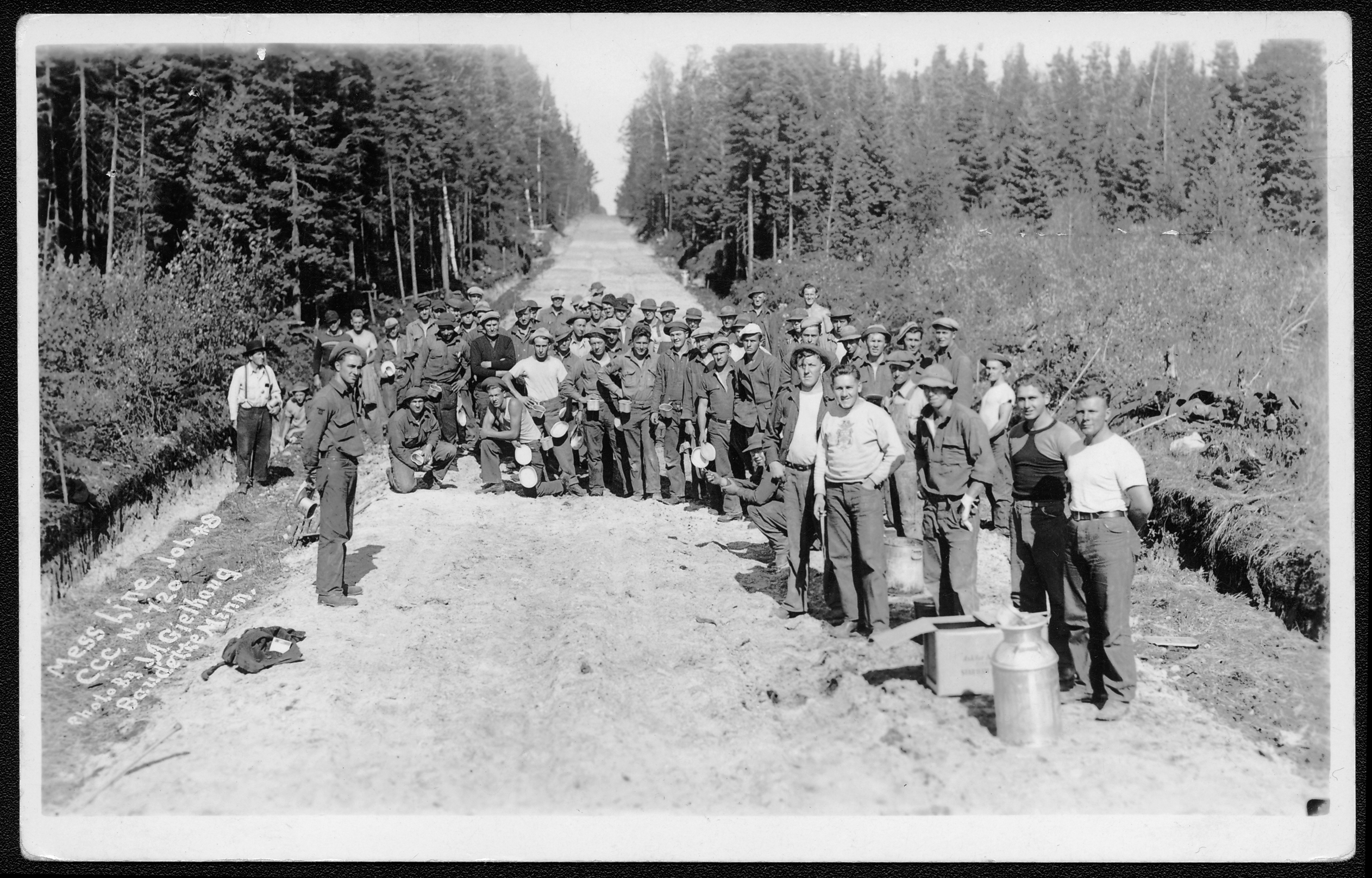

Full image.


Detail of custom sweatshirt. Appears to have the letters CCC, top center, in a design featuring an American eagle, trees as flanking columns supporting the CCC letters, and other hard-to-decipher iconography.

Document of the Day: 1935 Officer's Uniform Catalog

The CCC made a sharp distinction between officer's and enrollee's uniforms.

Unlike enlisted men, officers in the US Army purchased their own uniforms rather than being issued government-furnished garments from the Quartermaster Corps depots. Officer uniforms were individually tailored, often made in superior grades of fabric, and individuals were given considerable latitude in customizing them. The CCC followed the same practice.

US military officers serving as camp commanders, adjutants or doctors wore their military service uniforms while on active duty with the CCC.  However, the question arose as to whether and how the project supervisory staff assigned to CCC camps from the Department of Interior, Department of Agriculture, and state forest services should be uniformed. The same question arose concerning the camp Education Advisors, the only civilians directly employed by the ECW/CCC itself.

Vintage images suggest that most technical staff were not uniformed most of the time. Whether from the Soil Conservation Service, the US Forest Service, National Park Service, Bureau of Reclamation, or other agencies, supervisors most often show up in photographs in whatever idiosyncratic combination of workwear and civilian business wear they found comfortable.

In 1935 there does seem to have been a push to have technical branch supervisors wear either their own service uniform (NPS and USFS), or, if their parent branch had no uniform, a generic CCC officer's uniform. The specs seem to have loosely followed US Forest Service practice. 

Below is a link to a 1935 catalog for CCC Officer's uniforms from Fechtheimer Bros, the prominent Cincinnati-based purveyor of military uniforms and coats, issued in response to the 1935 mandate. The original is in the collections of the Denver Public Library.

Featured Reenactor: Veteran's Camp 2876

Historical reenactor Michael Kirby of Frederick, MD and friends are now appearing at select military encampments and reenactments in the Maryland-Pennsylvania area as "CCC Veteran's Camp 2876." Their group impression incorporates some really amazing 1930s material culture. Images provided by Mike Kirby and reproduced with permission.


Buyer's Guide Added to Handbook

A new section, the CCC Reenactor Buyer's Guide, has been added to the Civilian Conservation Corps Uniforms Handbook.

This spreadsheet provides sources for modern reproductions, where available, or acceptable substitutes for most of the CCC-issue garments covered in the Handbook.

Monday, April 15, 2019

Website of the Day: Camp Wolverine

Reader Scott Gerych of the Michigan Military History Museum has sent a link to a local history website he has compiled for Camp Wolverine, 673rd Company, located in Chandler Township Charlevoix County MI.

Scott has done an extraordinary job of weaving together contemporary newspaper articles with images from camp albums. The result is a granular, almost week by week portrait of the camp in its first year. You can follow the whole process from announcement of the Corps, selection of local enrollees, arrival of the 673rd in town, and slow transformation from tent camp to a permanent camp.

Well worth a look!

Link: https://chandlertownshipmichiganmemories.weebly.com/camp-wolverine-ccc.html

Sunday, April 14, 2019

Footwear Section of Handbook Revised

An extensive overhaul of the Footwear section of the Handbook is now live. New content on civilian caulk boots, low quarter Oxfords, and 1920s-era trench shoe auctions.

Friday, April 12, 2019

Welcome to the Civilian Conservation Corps Uniforms Blog

Welcome to the Civilian Conservation Corps Uniforms blog. This is a companion site to The Civilian Conservation Corps Uniforms Handbook, now finished. Follow along here for sidebar discussions, minor updates, pictures of the day, impressions of the day, cool auction links, and other such CCC uniform miscellany.